Monopoly Lost: Atlantic City's Rise and Fall
AP, 31-May-11
By WAYNE PARRY
Four years ago, some Atlantic City casino customers were shelling out $1,000 for a brownie sprinkled with edible gold dust in a Baccarat crystal they could take home.
Nowadays, some wait until 11 p.m. to eat so they can get a steak dinner for $2.99.
At the beginning of 2007, Atlantic City's 11 casinos were at the top of a wave of prosperity. Starting with the 1978 opening of Resorts, the nation's first casino outside Nevada, Atlantic City for years was the only place to play slots, cards, dice or roulette in the eastern half of the United States. The cash kept pouring in, the busloads of visitors kept coming and the revenue charts went one way: straight up.
And then, they didn't. Now, battered by competition from casinos all around it, Atlantic City is in a fight for its very survival.
The resort is furiously trying to remake itself into a vacation destination that happens to have gambling, but with no guarantee it has a winning hand even as other threats loom, including the possible expansion of casinos to north Jersey racetracks and a growing push for online gambling.
Intoxicated by years of success, Atlantic City missed numerous opportunities to diversify its offerings, widen its customer base and fend off competition that clearly was on its way even 20 years ago.
"The atmosphere was a total irrational exuberance; it truly was," said Robert Griffin, CEO of Trump Entertainment Resorts, who worked at Trump properties here in the 1980s and 1990s. "There was a feeling that there was no end to the good times and that the money would never end."
Then, disaster struck the nation's second-largest gambling market. A perfect storm of competition right on its doorstep in Pennsylvania, New York and Delaware, coupled with the recession, pummeled Atlantic City worse than any other casino market. In four years, a billion and a half dollars vanished, along with thousands of jobs and tourists. Pennsylvania, with its 10 casinos, is poised to knock Atlantic City into third place at some point next year.
How did things go so wrong so fast?
Cars streamed into Atlantic City on May 26, 1978, and people lined the Boardwalk for blocks, waiting to get inside Resorts on the first day it was legal to gamble there.
People bought tickets for buffets they had no intention of eating, just to sneak inside the casino earlier than the rest. Men relieved themselves into plastic coin cups to avoid losing their spot at the tables by going to restrooms. And cash — more than anyone had ever seen and more than management could imagine — flooded into the counting room, to the point that it took nearly an entire day to count it.
"It was euphoria," said Steve Norton, who was Resorts' executive vice president when it opened and now runs a casino consulting firm in Indiana. "I mean, it was an unbelievable time."
One after another in the 1980s, casinos kept coming. Revenues reached a high point of $5.2 billion in 2006.
And then the Pocono Downs harness racing track in Luzerne County, Pa., added slot machines and opened them to the public on Nov. 14, 2006. Suddenly, people in the heart of one of Atlantic City's key feeder markets could drive 10 or 20 minutes to play the slots instead of making a three-hour round trip to Atlantic City. In less than four years, there would be 10 casinos in Pennsylvania, all of which now offer table games, too.
They took in nearly $2.5 billion last year, approaching Atlantic City's $3.6 billion. So far this year, they are running neck-and-neck: $996 million for Pennsylvania, and $1.1 billion for Atlantic City.
"If you didn't anticipate this competition coming, you were asleep at the wheel," said Israel Posner, executive director of the Lloyd Levenson Institute of Gaming at Richard Stockton College of New Jersey.
David Schwartz, director of the University of Nevada-Las Vegas Center for Gaming Research, said Atlantic City can be successful again, "but it's going to require a reinvention."
"Basically, the city needs to stop looking backward and start looking ahead," he said.
A look back reveals many missteps and lost opportunities. The most obvious: a failure to reinvent the resort as a place to go for more than gambling. Atlantic City belatedly jumped on the bandwagon, adding non-gambling amenities over the past eight years like celebrity restaurants, spas, shopping and top-name entertainment. The Borgata even built a stand-alone luxury hotel called the Water Club, and Harrah's indoor pool has become a cash cow, doubling as one of the city's hottest nightspots.
But back then, anything customers couldn't bet on was seen as a waste of money.
"Nobody wanted to build anything other than casinos," Norton said. "The property values shot up so high, it didn't make sense to build anything else."
There's plenty of blame to go around. Casino owners focused only on their own properties instead of the market as a whole, a habit that Atlantic City is only recently shaking off. Competing against each other instead of Las Vegas was the city's playbook for decades.
Now, the casinos are banding together for joint marketing efforts, and will chip in to help sponsor the biggest names in entertainment, rather than letting one casino pay the whole cost of a Britney Spears or Lady Gaga show, or a rodeo. And three casinos are even thinking of jointly funding a new convention or trade show center in Atlantic City to draw badly needed midweek business.
New Jersey also erred by failing to approve legalized sports betting in 1991 when it was given the chance to do so ahead of a nationwide ban, gambling experts say. A state senator sued the federal government in 2009 to overturn the Professional and Amateur Sports Protection Act, but the suit was dismissed by a federal judge last month.
When Griffin, the Trump CEO, lays his head on the pillow at night, he worries that New Jersey will one day succumb to political pressure from lawmakers in the more populous northern part of the state to expand casino gambling to the Meadowlands racetrack, 10 minutes from New York City. Analysts expect it would instantly become a $1 billion market. State law now allows casino gambling only in Atlantic City.
"That would devastate us," he said. "This would become a two-casino town; it wouldn't even take five years. That's what keeps me up at night."
Maddie Downey, a bartender at the Showboat, has her own worries. The single mom has already lost one casino job when the Sands closed in 2006, and worries that gas prices will stay near $4 a gallon, keeping people away from Atlantic City.
"I'm just glad to have this job," she said. "I just hope it doesn't get any worse, and I hope the price of gas comes down."
When the Indian-run Foxwoods casino opened in Connecticut in 1992, it was the closest casino to Atlantic City — and a sure sign that more were to come. Mohegan Sun, another tribal casino, opened in Connecticut four years later. The resort responded by allowing its casinos to stay open 24 hours a day; they formerly had to close for a few hours in the wee hours of the morning. It also introduced new games like poker, keno and racing simulcasts.
But the money kept coming in, and the two Connecticut casinos didn't prove to be a major problem for Atlantic City, which sat on its cards. No new casinos opened until the Borgata in 2003, which would usher in a new era of grand dreams — very few of which would ever come true.
The Borgata touched off a casino arms race, with companies from across the country vying to build the next mega-resort here. At the start of 2008, there were plans for as many as four new casinos; MGM Mirage unveiled a $5 billion, three-tower casino project that would have been the largest ever built here.
Pinnacle Entertainment blew up the Sands to make way for its own $2 billion casino resort, modeled on a beach house. Before setting off the explosives that would bring it down, then-CEO Dan Lee spoke of the importance of keeping the market fresh, new and exciting. The challenge, he said, is "to compete in this new world, or be the next implosion."
Yet by the end of 2008, Pinnacle and MGM's projects imploded on their own, and Revel, the first of the new projects to actually put shovels in the ground, was limping along. It would run out of money in 2009 and halt construction on the interior. Morgan Stanley, its major financer, walked away from the project, deciding it was better to take a nearly $1 billion bath on the deal than to stay in Atlantic City.
After scouring the globe for financing, including asking the Chinese government, Revel CEO Kevin DeSanctis finally secured new financing in February 2011 that allowed the project to resume, with some state tax incentives.
"Every market got hit, but nobody faced the amount of new competition coming online as much as Atlantic City did," said Larry Mullin, who was president of the Borgata at the time and now runs an Australian casino company. "We were just exposed. Nothing was going to stop the convenience customer from trying a product that was closer to them. I just don't think there was any silver, magic bullet. It was a very tough situation."
Torn between demands from the New Jersey casino and horse racing industries, New Jersey's incoming governor, Republican Chris Christie, sided in 2010 with the casinos, which provided more tax revenue to the state's coffers. He refused to allow slot machines at the racetracks — something the racing industry has long wanted to keep pace with its competitors in other states.
New Jersey staged a quasi-takeover of Atlantic City's casino and tourist zones; Christie called it "a partnership." But the new tourism zone is run by the state and takes charge of many functions Atlantic City's often dysfunctional municipal government had long struggled with, including safety, cleanliness and economic development. (At one point just a few years ago, four of the previous eight mayors of Atlantic City had been arrested on corruption charges.)
The $30 million in annual payments that the casinos had to pony up to the horse racing industry, in return for keeping slots out of the tracks, will now be used to market Atlantic City nationally. The state rewrote many of its famously strict regulations for casinos, removing, among other things, minimum staffing requirements. They even allowed casinos to keep some jackpots that had built up on progressive slot machine games that they decide to cancel.
State-mandated economic redevelopment funds collected from each casino will now be used solely for projects within Atlantic City; before, the money was spread around the state.
The help cannot come too soon. Casinos are selling at fire-sale prices. Within the past year, The Tropicana, Resorts and Trump Marina have all sold for about 10 cents on the dollar from their values of just a few years ago. The Atlantic City Hilton stopped paying its mortgage in 2009 and is looking for a buyer. The casinos have shed nearly 15,000 jobs since 1997, with more layoffs to come.
The extra marketing money is crucial to Atlantic City's future, said Frank Fantini, a Delaware casino consultant and publisher.
"If it can create that same, "I gotta go party!' atmosphere that Las Vegas has, it ought to be able to work," he said.
Griffin, the Trump CEO and Casino Association president, said Atlantic City should bottom out at around $3.5 billion, then slowly start to grow again.
"There's a lot of pain coming, but I strongly believe that in 2012 you're going to see us coming back," he said. "I definitely think better days are ahead for Atlantic City."
Could that be a new marketing slogan for Atlantic City? Most of America seems to know that "what happens in Vegas stays in Vegas." Yet how many people can correctly cite Atlantic City's tourism slogan, "Always Turned On"? The resort is thinking of a new slogan.
The effort has been going on for three years.
Wednesday, June 01, 2011
Sunday, May 15, 2011
Election Upset in West New York
Hudson Reporter, 15-May-11
By Santo Sanabria
Roque slate wins by large margin
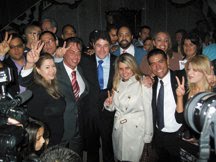
The community of West New York was surprised Tuesday night when longtime Mayor Sal Vega and his Board of Commissioners lost their re-election bids to a band of largely political newcomers led by local doctor Felix Roque.
After the town’s high taxes spurred Roque to begin a thwarted recall effort against Vega two years ago, Roque continued his political involvement, putting together a slate of candidates to take Town Hall.
In West New York’s form of government, voters elect five commissioners to run the town, and that group elects one of them mayor.
Roque said on Wednesday that he will be the mayoral choice when his slate takes office this coming Tuesday.
The West New York election results turned out to be a surprise for many in the community. Felix Roque had the highest vote total, with 3,763.
Count Wiley had 3,236, Caridad Rodriquez had 3,349, FiorD’ Aliza Frias had 3,219, and Ruben Vargas had 3,215.
Just behind them, Mayor Silverio “Sal” Vega had 3,137, Michele Fernandez-Lopez had 2,809, Lawrence Riccardi had 2,864, Albert Rodriguez had 2,830, and Gerald Lange had 2,802.
Independent candidate Ercides Aguasvivas got a mere 238 votes.
New leaders in Town Hall
Tuesday night, at Roque’s 60th Street headquarters, his supporters chanted repeatedly, “Llego papa,” which means “Dad has arrived.”
“We are going to make a difference,” Roque announced after learning he had won. “Your children can now have the same dreams I had as a kid”
Count Wiley asked the crowd of supporters “what do you want? What do you have?” while the crowd shouted “freedom!”
Roque and Wiley continually thanked God for the victory.
Walking to Town Hall
Roque and his slate and followers then walked to Town Hall, where Vega and his supporters had been counting votes earlier in the evening. But Vega had already left.
Initially Roque was not allowed up the steps to address the people, but soon, the police allowed him to climb the steps.
A Town Hall worker came outside and read the results aloud.
“Tomorrow we are going to have a party,” shouted Roque to his supporters. “God is great.”
He added, “I was told I won, but you truly won. You made me win. I am excited for the people. The people put me on this mission, and I spearheaded the movement.”
“These whole three years I did it for the people,” Wiley said. “I put my heart and soul into this and I am glad it did not go in vain. I am happy with the outcome.”
Ruben Vargas said, “I feel great to liberate the people from the last administration, where crime was sky high.”
A changing of the helm
The newly elected commissioners will be sworn Tuesday, May 17 at 12 p.m. at West New York Town Hall.
Roque said that his goals for the future include lowering taxes and cutting the crime rate.
Vega spokesman and political consultant Paul Swibinski said Wednesday that he believes the results can be attributed to “February 2009 when the town needed to raise taxes. Nothing could have repaired the damages of the taxes, but it is part of a democracy. We congratulate the Roque team in running a good campaign. We will cooperate during transition for it to run smoothly for the best interest of the people of West New York.”
Other sources said that the county’s political machine, the Hudson County Democratic Organization, did not come through to help Vega fend off Roque’s challenge.
Roque Campaign Manager Joe Demarco said, “We always believed we could do it. Those voters that wanted to vote, we made sure they had an opportunity. We had great passion and the people’s support to help us during the elections.”
He said that the supporters who were involved in the recall effort were involved in the win.
Sunday, May 08, 2011
Profile: Arianna Huffington
Arianna Huffington: mover and shaper
The Telegraph, 7-Feb-2011
By Mick Brown
Arianna Huffington this week became an internet mogul. Mick Brown examines her unstoppable rise
In a career spanning some 40 years, Arianna Huffington, once described as "the most upwardly mobile Greek since Icarus", has worn many faces.
She has been an author, polemicist, radio talk-show host, sometime staple of British newspaper gossip columns, a Republican political wife, a failed gubernatorial candidate, a woman who has journeyed across the political spectrum from ardent conservative to committed liberal. Indeed, looking at her CV, it can sometimes seem that Huffington has not so much had several cycles in one life, but several lives – to which can now be added yet another incarnation: media mogul.
This week it was announced that the The Huffington Post, the "internet newspaper" (as she describes it) that she edits, has been acquired by the internet provider AOL in a deal worth $315 million. Founded in 2005 by Huffington and the former AOL executive Kenneth Lerer, the HuffPo – as, excruciatingly, it has become known – has risen from being a marginal voice in the blogosphere to a prominent outlet for liberal opinion, and one of the most influential new-media platforms in America.
The HuffPo mixes content aggregated from traditional news outlets with in-house journalism, usually trumpeted in shouty upper-case headlines, and leavened with the obligatory dosage of celebrity gossip ("Christina Aguilera Totally Messes Up National Anthem"). But much of its following has been generated by a cast of bloggers that has included such disparate figures as Bill Clinton, Barack Obama, New York mayor Michael Bloomberg, Scarlett Johansson and Neil Young, as well as Huffington herself.
Its front page yesterday made no pretence at modesty, proclaiming the birth of "A BRAND NEW MEDIA UNIVERSE – Arianna: The Huffington Post & AOL – A Merger Of Visions".
Under the deal, Huffington will be president and editor-in-chief of the Huffington Post Media group, which will integrate all Huffington Post and AOL content, including news, entertainment, video and such AOL sites as Moviefone, MapQuest and TechCrunch. It is claimed that the new combined media group will reach 117 million Americans and 270 million globally.
Overnight it makes Huffington one of the major players in the rapidly changing world of global media. It is a position that all who know her say that Huffington will relish.
What Arianna Huffington has always craved is not so much power as influence. It seems that her life's journey has been to get to the centre of the action, wherever that action may be, in the process accumulating as many useful allies as possible. An indefatigable networker and name-dropper, she is on first-name terms with a who's who of American life, from entertainment, politics and business. It would be tempting to say that she has the most compendious Rolodex in America – except that Huffington, of course, does not do Rolodex, instead running her life with three BlackBerries, which she claims to hide in the bathroom at night to ward off temptation.
Huffington was born Arianna Stassinopoulous in Athens in 1950. Her parents had been active in the Greek resistance movement during the war. Her father Constantine was a journalist who edited a resistance newspaper, survived internment in a Nazi concentration camp and later became a publisher and management consultant. When Arianna was 16, her parents separated and she moved to Britain with her mother and her younger sister Agapi to take the entrance examinations for Cambridge. Arianna was duly awarded an exhibition to Girton to study economics.
Displaying the ambition and determination that would become her salient characteristics, she rose to become president of the Cambridge Union, earning herself the unkind sobriquet "Staryanna Comeacroppalos". Chris Smith, the former Labour minister and now Lord Smith of Finsbury, and a contemporary at Cambridge, recalls her as "a very prominent figure", who became known for her habit of leaving her Alfa Romeo parked on double yellow lines, accumulating parking tickets.
"She was very striking and very glamorous, probably more of a socialite than a political figure but the liberal icon she has since become was not very evident in her student days. She was very much of the Right. I was regarded as being of the Left, and therefore the enemy."
After graduating in 1972, she was romantically linked with the Conservative MP John Selwyn Gummer and the journalist Simon Jenkins, before meeting Bernard Levin, The Times columnist and polymath, and the man she would later describe as "the big love of my life". She was 21. Levin was 42. She prepared for their first date by boning up on the latest developments in the Soviet Union and the music of Wagner. The relationship would last eight years, finally ending in 1980 over Levin's reluctance to have children. Following his death in 2004, she described him as her "mentor as a writer, and a role model as a thinker".
Huffington once recalled that Levin used to tell her "that going to bed with him was a liberal education". And education – or rather a furious appetite for self-improvement – has been a Huffington hallmark. At the age of 23 she wrote The Female Woman, a rebuttal to Germaine Greer's The Female Eunuch; she has since written serviceable biographies of Maria Callas and Picasso, self-help manuals, spiritual tracts and a novel about Bill Clinton's relationship with Monica Lewinsky.
With Levin, she became enamoured of the controversial Indian guru Bhagwan Shree Rajneesh, the Rolls-Royce loving leader of the "Orange People", who promulgated a melange of traditional spiritual teachings and pop psychology nostrums. She departed from Rajneesh before he was engulfed in scandal, but her enthusiasm for new age thinking has been a constant in her life.
She went on to date Werner Erhard, a former encyclopaedia salesman whose organisation est made him one of the foremost self-help gurus of the 1970s, and she would later become a follower of another new age guru, Roger Delano Hinkins, known as "John-Roger", whose Movement for Spiritual Inner Awareness was the subject of a series of exposés in the Los Angeles Times in 1988, in which former members described it as sexually and financially exploitative.
She was reportedly "ordained" as a minister in the movement, and her former husband Michael Huffington, the Republican politician and scion of a Texas oil family to whom she was married for 11 years, would later describe John-Roger as having "more influence on her than anyone else in the world". Much of Huffington's philosophy remains steeped in the conviction that mankind is on the verge of, as she puts it, "a breakthrough in our evolution". She continues to pray, meditate and practise yoga daily and is an ardent exponent of green issues.
Her introduction to Michael Huffington came in 1985. Following the break-up with Levin, she had left London for New York with her mother, heeding the advice of the publisher Lord Weidenfeld to befriend the wives rather than the husbands of the East Coast power-broking elite. It was advice that would ultimately lead to her friendship with the philanthropist Ann Getty, who not only introduced her to Huffington but graciously footed the bill for their wedding in 1986. Henry Kissinger was among the 500 guests, observing that it had everything but ''an Aztec sacrificial fire dance''. Barbara Walters was a bridesmaid. Huffington's ascendancy to the summit of American society was complete.
The couple based themselves in Washington, where Michael Huffington was a deputy assistant secretary of defence in the Reagan administration, before moving to California in 1988 where he ran for, and won, a seat in Congress. In 1994 he ran for a senate seat, exhausting almost $30 million of his fortune but losing. The Republican strategist Ed Rollins, who managed Michael Huffington's campaign, would later describe Arianna as "domineering" and "the most ruthless and ambitious person I'd met in 30 years in national politics".
The couple divorced three years later, with Huffington explaining that "Michael decided that he wanted to go off to Europe and go on a boat, and I wanted to pick up my life and continue writing". The marriage produced two daughters, Christina, 21, and Isabella, 19.
Arianna, meanwhile, was advancing her own entry into politics. In 1995, she became a senior fellow at the Progress and Freedom Foundation, a conservative think tank founded by the Republican Speaker of the House, Newt Gingrich, and hosted a talk-show on a conservative cable-channel, National Empowerment Television.
But she was undergoing a sea change in her political views. In 2003 Huffington entered the California gubernatorial race as an independent against Arnold Schwarzenegger. Her campaign came to a swift close when it was revealed that she had paid only $771 in taxes for the previous two years. (Huffington claimed that the bulk of her income was child-support payments.)
Huffington has attributed her move from Right to Left to a growing belief that the private sector could not solve America's problems. Much of the Huffington Post's rising popularity came from her support for Barack Obama (at least at the time when his popularity was in the ascendant). And while her enthusiasm for Obama has waned, she has remained a strident critic of the far Right and the Tea Party movement - her sentiments summarised in the wordy title of her 2008 book Right Is Wrong: How The Lunatic Fringe Hijacked America, Shredded The Constitution and Made Us All Less Safe. (Sarah Palin, we may surmise, is not on the Huffington BlackBerry.)
Her merger with AOL, she has promised, will not temper the HuffPo's line. ''Far from changing our editorial approach," she wrote in an editorial yesterday, ''our culture, or our mission, this moment will be, for HuffPost, like stepping off a fast-moving train and on to a supersonic jet. We're still travelling toward the same destination, with the same people at the wheel, and with the same goals, but we're now going to get there much, much faster.''
Quite what this destination might be, she does not specify. But for Arianna Huffington, just getting there quickly has always been the point.
Tuesday, April 19, 2011
Sudhir Sherchan Wins CMS Cup Golf
Sudhir Sherchan Wins CMS Cup Golfmyrepublica, 9-April-11
Sudhir Sherchan won the title of the CMS Cup Golf Championship at the Royal Nepal Golf Club (RNGC) on Saturday.
Sherchan scored 36 points to win the trophy and Omega watch in the amateur golf championship sponsored by International Society of Medical Education (ISME).
Lakshman Pun, who scored 34 points on Friday, finished runner-up while DT Sherpa won the award for best gross. Pun received a Samsung Mobile and runner-up trophy and Sherpa bagged two-way air-ticket to Kathmandu-Bangkok-Kathmandu along side the trophy.
Overnight leader LP Gurung claimed the title in the senior category, where Kiran S Thapa finished second. Gurung had a score of 35 points while Thapa had scored 32.
Rekha Ghimire scored 29 points to claim the award for ladies winner. Sumitra Dayananda was runner-up with 26 points.
Likwise, Jayendra Shah and Sameer Acharya were winner and runner-up respectively in the guest section.
Shree Jay Acharya won the award for longest drive while Rabin Rana hit three birdies to bag most birdies award. Kajiman Gurung got the award for closest to the pin and Gaurav SJB Rana received best sportsmanship prize.
Krishna Nepal was adjudged best caddy of the year while Gopal Chitrakar received a special prize.
CEO and Chairman of ISME Nagender Pampati expressed his delight on the successful completion of the event. "I´m happy to see increasing number of participants," said Pampati.
RNGC President Prachanda Bahadur Shrestha handed a token of appreciation to Pampati for sponsoring the tournament.
Altogether 96 golfers participated on the championship played over 18 holes under stable ford format with 7/8 Handicap allowance. Among them, 32 teed off on Friday and the remaining 64 golfers teed off on Saturday.
Tuesday, March 22, 2011
Thursday, March 03, 2011
Book Review: "Leben oder gelebt werden"
Book Review: "Leben oder gelebt werden"Bloomberg, 3-Mar-11
By Catherine Hickley
Some parents cast a really huge shadow.
Pity Walter Kohl, whose colossus of a father, Helmut, was Germany’s longest-serving chancellor since Otto von Bismarck.
Now 47, Walter recounts a troubled childhood, struggles with depression and suicidal urges in “Leben oder gelebt werden” (“Live or Be Lived”), currently topping Spiegel magazine’s non-fiction bestseller list.
His book depicts a preoccupied father who retreated to his study after meals on the rare occasions he was home and only played with his two sons for magazine photo shoots.
Unsurprisingly, they are estranged.
“Politics is his elixir of life, everything else is secondary,” Kohl writes.
Helmut Kohl’s wife, who killed herself with an overdose in 2001, took responsibility for the family and household.
Portrayed by Walter as a strict yet loving mother and a long- suffering, dutiful spouse, Hannelore Kohl felt torn between her husband’s public role and her sons’ need for normalcy.
The two were irreconcilable, Kohl writes.
There was nothing normal about going to school with a police escort, taking vacations surrounded by diplomats and journalists, or facing the daily threat of kidnapping -- and worse -- during the peak of the Baader-Meinhof gang’s terror campaign.
Escape to Harvard
After a spell in the army, Kohl fled to Harvard University, and made friends who had no interest in German politics.
He then joined Morgan Stanley as an IPO analyst. He recalls proudly showing his father his workplace in a Wall Street tower block.
Helmut Kohl, who had “not the faintest idea what an investment bank did,” was horrified at the informal, partitioned offices and functional furniture.
In July 1990, as German reunification approached, the cover of Time magazine caught his eye in a New York supermarket. His father’s face, emblazoned with the headline “Mr. Germany,” hit him “like thunder,” he writes. “There was no peace, no anonymity anywhere -- not for me.” He does seem very sensitive.
Kohl moved back to Germany in 1994, deciding he no longer wanted to be a rootless immigrant or an investment banker for life.
Funding Scandal
Helmut Kohl lost the 1998 election and his party became embroiled in a funding scandal in 1999. His family was shaken to the core -- besieged by journalists and tarred with the same brush, Walter Kohl writes.
Driven to despair by the scandal and a bizarre allergy to light, Hannelore Kohl ended her life in 2001. Grieving and depressed, her son considered taking the same path, he writes.
In the years after her death, Kohl’s relationship with his father deteriorated. He wasn’t invited to Helmut’s wedding in 2008 and thinks new wife Maike Richter wanted nothing to do with the ex-chancellor’s family.
After giving a television interview that displeased his father, all contact ended. Kohl Senior hasn’t commented publicly on the book.
Writing “Leben oder gelebt werden” clearly served as therapy for a man who says he hit rock bottom in his late 30s.
Since then, Kohl has hauled himself out of a hole that he admits he partly dug for himself: He sank into self pity, constantly bemoaning the injustice of fate.
With his Korean wife, a son from his first marriage and a successful business importing car-making tools from Korea and China, Walter seems on the way to becoming his own man.
Subscribe to:
Posts (Atom)